Graph Partitioning Example
Graph Partitioning divides the nodes of a graph into equal-sized groups while minimizing the number of edges crossing between them. Applications include parallel computing, VLSI design, and load balancing.
import getpass
import os

import numpy as np
from dotenv import load_dotenv
from luna_quantum.algorithms import SCIP

from luna_usecases.graph_partitioning import (
    GraphPartitioningCollection,
    GraphPartitioningData,
    GraphPartitioningFormulation,
    GraphPartitioningInstance,
)

load_dotenv()
if "LUNA_API_KEY" not in os.environ:
    os.environ["LUNA_API_KEY"] = getpass.getpass("Enter your Luna API key: ")
Create Data
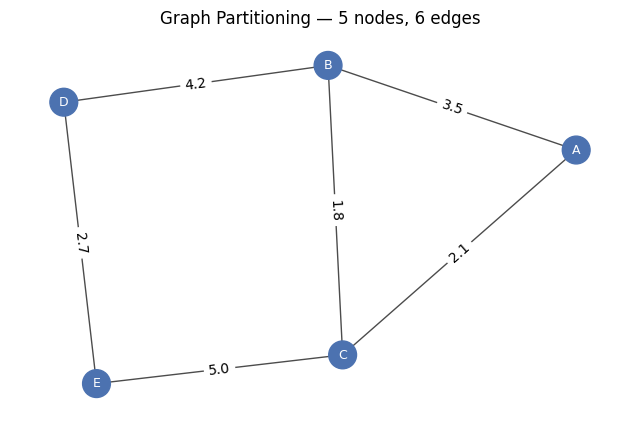
Define a 5-node weighted graph to partition into two balanced groups.
adj = np.array(
    [
        [0.0, 3.5, 2.1, 0.0, 0.0],
        [3.5, 0.0, 1.8, 4.2, 0.0],
        [2.1, 1.8, 0.0, 0.0, 5.0],
        [0.0, 4.2, 0.0, 0.0, 2.7],
        [0.0, 0.0, 5.0, 2.7, 0.0],
    ]
)
node_names = ["A", "B", "C", "D", "E"]
data = GraphPartitioningData.from_adjacency_matrix(adjacency_matrix=adj, node_names=node_names)
print(data.to_string())
Plot Data
Visualize the graph structure.
Create Formulation
Minimize edges between the two partitions while keeping group sizes balanced.
Graph Partitioning Formulation:
  Nodes: 5
  Edges: 6

Decision Variables:
  x[i] in {0,1} for i = 0, ..., 4
  x[i] = 1 if node i is in partition 1, else partition 0
  Total: 5 binary variables

Objective:
  minimize sum_False w_ij * (x[i] + x[j] - 2*x[i]*x[j])

Constraints:
  1. Equal partition size (1 constraint): n // 2 = 5 // 2 = 2
     sum_i x[i] == 2
Create Instance
Combine data and formulation into a solvable instance.
instance = GraphPartitioningInstance(data=data, formulation=formulation)
print(instance.to_string())
Data:Graph Partitioning Data:
  Nodes: 5
  Edges: 6
Formulation:Graph Partitioning Formulation:
  Nodes: 5
  Edges: 6

Decision Variables:
  x[i] in {0,1} for i = 0, ..., 4
  x[i] = 1 if node i is in partition 1, else partition 0
  Total: 5 binary variables

Objective:
  minimize sum_False w_ij * (x[i] + x[j] - 2*x[i]*x[j])

Constraints:
  1. Equal partition size (1 constraint): n // 2 = 5 // 2 = 2
     sum_i x[i] == 2
Formulate Model
Translate the instance into a mathematical optimization model.
Solve and Interpret
Solve the model with SCIP and interpret the raw result into a use-case-specific solution.
scip = SCIP()
job = scip.run(model)
sol = job.result()
uc_solution = instance.interpret(sol)
print(uc_solution.to_string())
/Users/maximilianjanetschek/PycharmProjects/luna-usecases/.venv/lib/python3.13/site-packages/rich/live.py:260:
UserWarning: install "ipywidgets" for Jupyter support
  warnings.warn('install "ipywidgets" for Jupyter support')
2026-06-16 21:16:50 INFO Sleeping for 5.0 seconds. Waiting and checking a function in a loop.
2026-06-16 21:16:57 INFO Sleeping for 10.0 seconds. Waiting and checking a function in a loop.
2026-06-16 21:17:13 INFO Sleeping for 15.0 seconds. Waiting and checking a function in a loop.
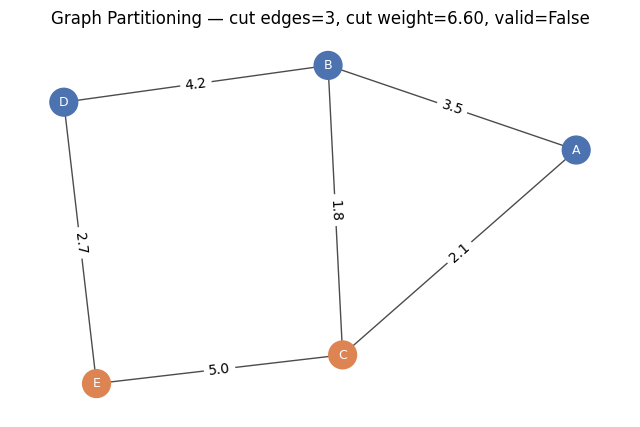
Graph Partitioning Solution:
  Cut edges: 3
  Cut weight: 6.60
  Valid: False
  Partition 0: ['A', 'B', 'D']
  Partition 1: ['C', 'E']
Plot Solution
Visualize the optimal solution.
Collections
Generate a benchmark collection of random instances for batch processing.